
This site is currently under construction. Please check back in a few days to see what’s been added!
UNIT TWO
*** Nothing in Creative Outlet Tracer Club content constitutes legal advice. ***
*** Please seek out an attorney for all legal matters. ***
NAME AND REGISTER YOUR BUSINESS
Coming up with a name for a creative business can be fun and frustrating at the same time.
You want it to be clever and unique and clearly represent you and what you do. But be careful about putting a spin on the words by changing the spelling. Your name must make sense to your audience. Same goes for your logo.
Consider: If you have to squint and think and wonder what something says, how likely are you to click their links or reach out and make contact? A company I’ve seen lately has the word ‘action’ in their name but they spell it: Aktion. It’s awkward and it gets me every time. I have to stop and look at it and then remind myself what it says.
Best practice is K.I.S.S. Keep. It. Simple. Sweetheart.
Once you come up with a name you like you will need to check to see if it’s available to use. Do this by checking the trademark data base at uspto.gov/trademarks/search. If someone has trademarked the words or phrase then it’s off limits for anyone else to use them.
When you find a name that is available, the next step is to check your state gov, or secretary of state, to see if it’s available there. Then you will start the registration process.
TIP: Come up with at least four varieties of your chosen name. Search them in order of your preference.
At this point you will have to determine how your business will be organized. Will you incorporate? Will you run it as an LLC or as a sole proprietor? Your state gov may require you to apply for various certificates or licenses. Each state is different. And there may be fees involved. These are all things to discuss with your accountant and attorney.
*** If you live somewhere other than the U.S., I don’t have any idea how you would go about registering your business. But I wish you all the best and most everything else in COTC should still be of use to you. ***
You may also need to register your business at the city or county level. This must all be done prior to opening a business bank account.
TIP: Your local Small Business Development Center is a great resource and can provide much guidance as you set up your business. More on that here: sba.gov/local-assistance/resource-partners/small-business-development-centers-sbdc


Why do all this?? I see a lot of people selling and doing side hustles without legalizing their business, collecting sales tax and such. Some may think it’s not necessary to go through all this red tape and possibly pay for licenses and fees for something as simple as paint parties. But if you want to be taken seriously, and if doing the right thing is important to you … Then get your ducks all in a row from the very start.
I believe we will all have to give an account someday, even for the small things. And Jesus said to give to Caesar what is Caesar’s.
So, get legit. Not only will others take your business more seriously – you will too. Each state and province are different. Find out what it takes in your area to get a business license. Getting your paint party business registered with state and local government is a huge first step. Way to go!! Celebrate that!!
TRADEMARKS AND COPYRIGHTS
What are they? And what do they matter? We’ll talk more about this subject in Unit Four. But as a creative business owner you need to be very aware of things like trademarks and copyrights.
As we create and sell art, we want to make very sure we do not infringe on anything protected by copyright or trademark law. Legally we cannot just find images online and use them for our own purpose – especially if we are making any money from it.
Trademark. Copyright. Commercial License. Public Domain. Attribution. Royalties. These are all terms I hope you will take a serious look at. Do some research and get very familiar with these concepts. Because in the art world they matter. They matter a lot.

BANKING, PAYMENT GATEWAYS & LANDING PAGES
Once you have all the proper licenses it’s time to open a business bank account. For me, this was the most expensive part of starting my paint party business. To avoid monthly fees, my bank required a $500 minimum balance. (It took me a little while to save the money. And today, I try to never let my balance drop below that because I don’t want to pay extra fees.)
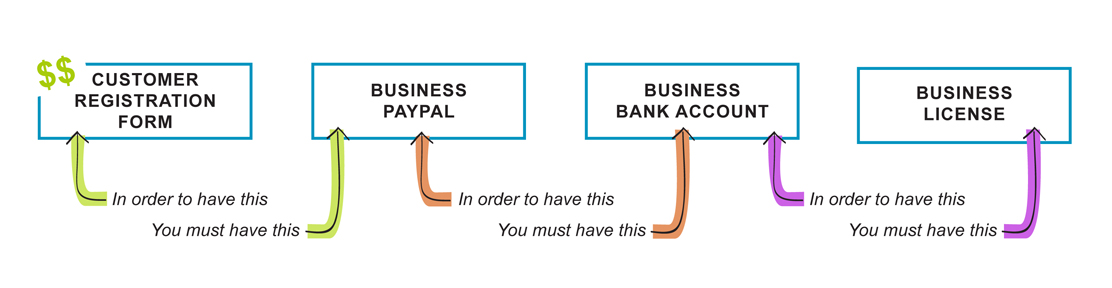
Keeping your personal and business finances separate is vital for bookkeeping. But it’s also necessary because you must have a business bank account in order to have a business payment gateway.
When the business bank account is in place, the next step is to decide how to collect payments from your customer. There are several options such as PayPal, Square and Stripe, to name a few. I will be using PayPal in my examples.
The payment gateway will connect to your bank account. Funds will be deposited into your account as guests register and pay for paint parties.
Let’s reverse engineer this:
TIP: A regular PayPal account can be upgraded to a Merchant account.
PAYMENT LINKS
The business version of a payment gateway comes with tools that a regular account doesn’t have – like buttons and links you can insert into a registration form.
Get familiar with your dashboard. Here you will find important stuff like dates and amounts of transactions. Also, tools to create invoices and buttons.
In PayPal, the BUY NOW button works well for registration forms. I like to create a new button for each party and name it something like: SNOWYNIGHT.11.08.2021. That way, as customers pay, I will know which party they are registering for.
TIP: Google and YouTube are your friends. Search ‘how to create a payment link.’
LANDING PAGES
A landing page is like a simple one-page website that can easily be created in an email service provider such as Constant Contact, Mailchimp or other. I’ll use Mailchimp in my examples. I like Mailchimp because it is free to use until your email list has more than 500 contacts.
Here’s what a typical landing page looks like:
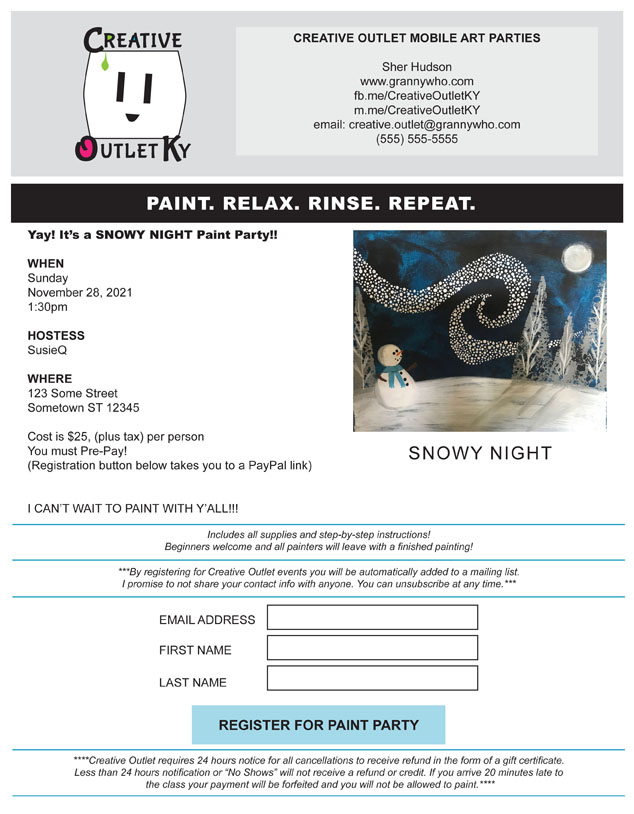
The landing page includes all the details, a mailing list disclaimer, the registration form and cancelation policy. The registration form takes the customer directly to your payment like and also adds them to your mailing list.
TIP: Create the PAYMENT LINK before you create the LANDING PAGE!
Once the landing page is all set up you will send the link to your hostess – by message, text or email. She, in turn, shares it with her friends and family.
When I send the link to my hostess, I like to include wording such as: Hey Susie. Here’s the registration form for your paint party! Everyone must register by 11/3. I can’t wait to paint with y’all! [paste the link]
All of this seems like a lot of work at first. And it is. But the original payment link and landing page can both be duplicated. Then it’s just a matter of updating the details.